When a school district begins planning a new facility or major renovation, there are a lot of factors that go into selecting the right construction partner.
Public school construction is different from a private construction project. Because school districts are public entities investing public funds, the process for selecting professional and construction services is shaped by state statutes, procurement requirements, public meeting laws, and the specific delivery method selected for the project.
In Florida, the Consultants' Competitive Negotiation Act (CCNA), Florida Statute §287.055, establishes requirements for the procurement of certain professional services, including architectural, engineering, landscape architectural, and surveying and mapping services. Florida's Sunshine Law, §286.011, also establishes requirements for public meetings and government decision-making.
Together with Florida's educational facilities statutes and local procurement requirements, these laws create a structured process for public school construction.
The process often starts with understanding the district's goals, budget, schedule, and the needs of the students and community who will use the facility. Before a project ever reaches the construction phase, a school district must make decisions about what it wants to build, what the project needs to accomplish, how it will be funded, and which construction delivery method is appropriate.
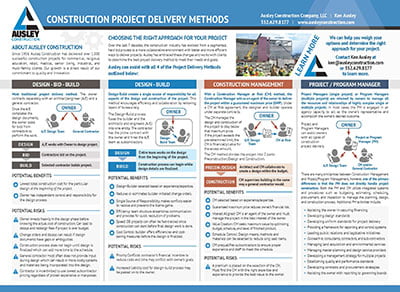
Florida Statute §1013.45 allows district school boards to use several construction approaches, including competitive bidding, design-build, and construction management. The delivery method matters because it can determine how the project team is selected and when the construction team becomes involved.
For applicable professional services, CCNA establishes a qualifications-based competitive selection process. For other construction delivery methods, the selection process may involve different requirements and evaluation criteria.
This means there is not one single process for selecting a construction partner for every Florida school project. The requirements depend on the project, the services being procured, and the delivery method selected by the public entity.
Because public school projects involve public resources, transparency is an important part of the process. Florida's Sunshine Law generally requires meetings of public boards and commissions at which official acts are taken to be open to the public, with reasonable notice and recorded minutes. There are also specific statutory exemptions that apply to certain portions of competitive solicitations and negotiations.
The goal is to provide accountability while allowing public entities to conduct the procurement process effectively. For school districts, this creates an open process in which decisions must be made within an established public framework.
That transparency also extends to the information used to evaluate potential project partners. Depending on the procurement and delivery method, districts may consider qualifications, experience, proposed approach, cost, schedule, and other criteria established for the project.
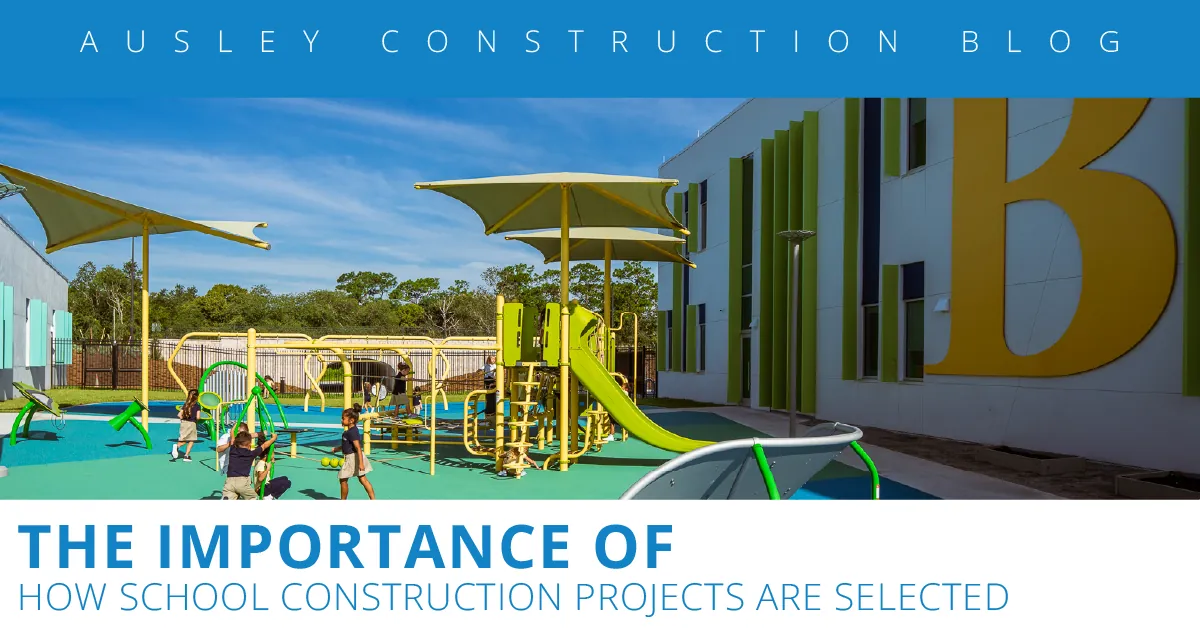
Experience with K-12 construction matters because school projects have unique requirements. Many projects take place on occupied campuses, which means construction has to be carefully coordinated around students, teachers, staff, and daily school operations.
A construction project may need to account for the school calendar, student and staff circulation, construction access, site logistics, safety, and communication with the school community. These considerations can begin influencing the project well before construction starts.
That is why experience with similar projects can be an important consideration when a district is evaluating potential construction partners. A contractor who understands the realities of K-12 construction can bring that perspective into preconstruction planning, helping identify potential challenges and develop a plan around the needs of the campus.
The right construction partner should bring experience, transparency, a sound budget strategy, and a plan for delivering the project on time.
Experience provides an understanding of the challenges that can arise during construction. Transparency helps keep the owner and project team informed as the project progresses. A sound budget strategy provides a realistic foundation for decision-making. And a thoughtful project plan helps establish how the work will be executed from preconstruction through completion.
For public entities, those qualities are particularly important because the construction partner is responsible for delivering a facility that will serve students, educators, and the broader community for years to come.
The process of selecting a construction partner is an important part of every school construction project. Florida's statutes and regulations provide the framework for how public entities procure services and select project teams.
The delivery method, applicable procurement requirements, public transparency laws, and project-specific criteria all play a role in shaping that process. But the objective remains the same: establish a project team that understands the goals of the public entity and can help deliver a successful project.
At Ausley Construction, decades of experience working with public-sector owners have shaped our understanding of the planning, coordination, and accountability required to successfully deliver K-12 projects.
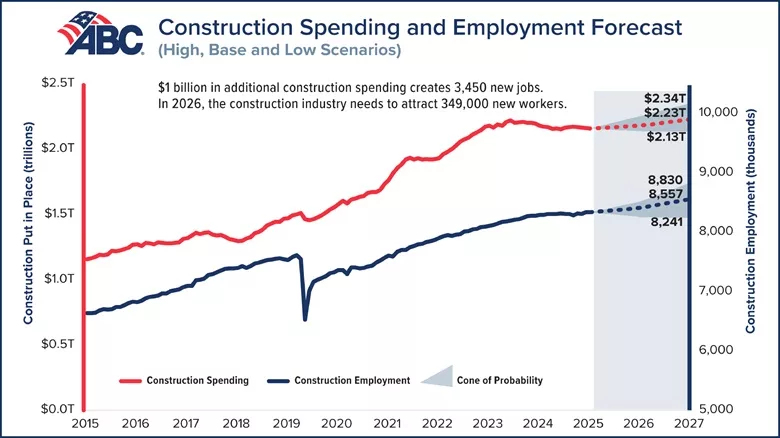
Across the construction industry, one of the most important conversations today is about the future of the workforce. Nationally and across Florida, demand for skilled labor has outpaced the number of trained professionals entering the field. As of January 2026, the Associated Builders and Contractors estimates 349,000 new workers will need to be added to the construction industry to maintain current supply and demand. Additionally, the National Center for Construction Education and Research estimates 41% of the current construction workforce nears retirement by 2031, further widening the labor gap.
Beyond our industry, as communities grow and infrastructure demands increase, the need for skilled professionals in public safety, healthcare, and technical trades continues to rise. This urgency inspires us at Ausley Construction to invest meaningfully in the people who design, build, protect, and maintain the spaces our communities depend on.
That belief is why Ausley Construction partnered with the Public Education Foundation of Marion County to establish a $25,000 scholarship fund supporting local students pursuing high-skill, high-wage careers.
The State of Florida defines “high skill, high wage” careers as professions that require specialized training, technical knowledge, or certification and offer strong long-term earning potential. Many of these careers are also essential to the continued growth and stability of local communities.
The Ausley Construction scholarship program supports Marion County high school seniors pursuing careers in fields such as:
These careers represent the backbone of thriving communities. From the builders who construct our schools and hospitals to the teachers, nurses, and first responders who serve within them, each role plays a critical part in creating places where people can live, work, and grow.
By supporting students entering these fields, the scholarship program helps create a pipeline of skilled professionals who will continue strengthening Marion County for decades to come.
Workforce development initiatives like this scholarship program are one way communities can begin addressing the labor gaps in major industries, including construction. By encouraging students to pursue technical training, certifications, apprenticeships, and specialized education, organizations can help create clearer pathways into stable, rewarding careers.
Construction offers opportunities for long-term growth, competitive wages, and meaningful work that leaves a visible impact on communities. Whether someone chooses a path in project management, skilled trades, engineering, or construction operations, the industry provides career opportunities that can last a lifetime.
Ausley Construction’s scholarship commitment also reflects the company’s longstanding relationship with education in Marion County. Over the past several decades, the firm has helped build many of the schools and educational facilities that serve students across the region today.
Supporting students who will go on to work in these essential fields represents a natural extension of that work.
When businesses, schools, and community organizations collaborate, they create opportunities that reach far beyond a single project or program. Scholarships help open doors for students who are ready to work hard, develop specialized skills, and contribute to their communities in meaningful ways.
At Ausley Construction, our mission has always been to build facilities that serve communities for generations. That mission extends beyond the buildings themselves.
It includes investing in the people who will shape those communities in the future.
Through partnerships like the Public Education Foundation scholarship program, we are proud to support the next generation of builders, educators, healthcare professionals, and public servants who will carry our communities forward.