When a school district begins planning a new facility or major renovation, there are a lot of factors that go into selecting the right construction partner.
Public school construction is different from a private construction project. Because school districts are public entities investing public funds, the process for selecting professional and construction services is shaped by state statutes, procurement requirements, public meeting laws, and the specific delivery method selected for the project.
In Florida, the Consultants' Competitive Negotiation Act (CCNA), Florida Statute §287.055, establishes requirements for the procurement of certain professional services, including architectural, engineering, landscape architectural, and surveying and mapping services. Florida's Sunshine Law, §286.011, also establishes requirements for public meetings and government decision-making.
Together with Florida's educational facilities statutes and local procurement requirements, these laws create a structured process for public school construction.
The process often starts with understanding the district's goals, budget, schedule, and the needs of the students and community who will use the facility. Before a project ever reaches the construction phase, a school district must make decisions about what it wants to build, what the project needs to accomplish, how it will be funded, and which construction delivery method is appropriate.
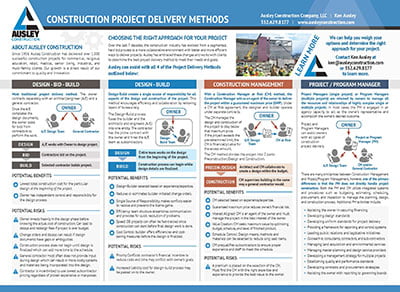
Florida Statute §1013.45 allows district school boards to use several construction approaches, including competitive bidding, design-build, and construction management. The delivery method matters because it can determine how the project team is selected and when the construction team becomes involved.
For applicable professional services, CCNA establishes a qualifications-based competitive selection process. For other construction delivery methods, the selection process may involve different requirements and evaluation criteria.
This means there is not one single process for selecting a construction partner for every Florida school project. The requirements depend on the project, the services being procured, and the delivery method selected by the public entity.
Because public school projects involve public resources, transparency is an important part of the process. Florida's Sunshine Law generally requires meetings of public boards and commissions at which official acts are taken to be open to the public, with reasonable notice and recorded minutes. There are also specific statutory exemptions that apply to certain portions of competitive solicitations and negotiations.
The goal is to provide accountability while allowing public entities to conduct the procurement process effectively. For school districts, this creates an open process in which decisions must be made within an established public framework.
That transparency also extends to the information used to evaluate potential project partners. Depending on the procurement and delivery method, districts may consider qualifications, experience, proposed approach, cost, schedule, and other criteria established for the project.
Experience with K-12 construction matters because school projects have unique requirements. Many projects take place on occupied campuses, which means construction has to be carefully coordinated around students, teachers, staff, and daily school operations.
A construction project may need to account for the school calendar, student and staff circulation, construction access, site logistics, safety, and communication with the school community. These considerations can begin influencing the project well before construction starts.
That is why experience with similar projects can be an important consideration when a district is evaluating potential construction partners. A contractor who understands the realities of K-12 construction can bring that perspective into preconstruction planning, helping identify potential challenges and develop a plan around the needs of the campus.
The right construction partner should bring experience, transparency, a sound budget strategy, and a plan for delivering the project on time.
Experience provides an understanding of the challenges that can arise during construction. Transparency helps keep the owner and project team informed as the project progresses. A sound budget strategy provides a realistic foundation for decision-making. And a thoughtful project plan helps establish how the work will be executed from preconstruction through completion.
For public entities, those qualities are particularly important because the construction partner is responsible for delivering a facility that will serve students, educators, and the broader community for years to come.
The process of selecting a construction partner is an important part of every school construction project. Florida's statutes and regulations provide the framework for how public entities procure services and select project teams.
The delivery method, applicable procurement requirements, public transparency laws, and project-specific criteria all play a role in shaping that process. But the objective remains the same: establish a project team that understands the goals of the public entity and can help deliver a successful project.
At Ausley Construction, decades of experience working with public-sector owners have shaped our understanding of the planning, coordination, and accountability required to successfully deliver K-12 projects.